

Offense vs. Defense: A New Way to Think About How People Shop
September 17, 2026Offense vs. Defense: A New Way to Think About How People Shop
September 17, 2026Insights
Does Trust Win the Game? What Costco Shoppers Tell Us

Last time, we introduced two ways to think about how shoppers respond to something unplanned: behavior, whether they actually buy it, and mindset, whether they're looking for a reason to say yes or a reason to say no. We found the two don't move together as tightly as you might expect, and mindset looked like the more interesting lever for retailers to pull, since it isn't just a byproduct of how often someone shops. This time, we explore what might actually drive that lever. The obvious first guess is trust. So we started with the retailer our respondents trust most: Costco (full disclosure, also a favorite of ours).

Abundant in Trust, Lagging in Offensive Mindset
Costco earns the second-highest trust score of any chain in our study, just behind Whole Foods, and about three in four Costco shoppers say they trust the retailer "a lot" or "completely."
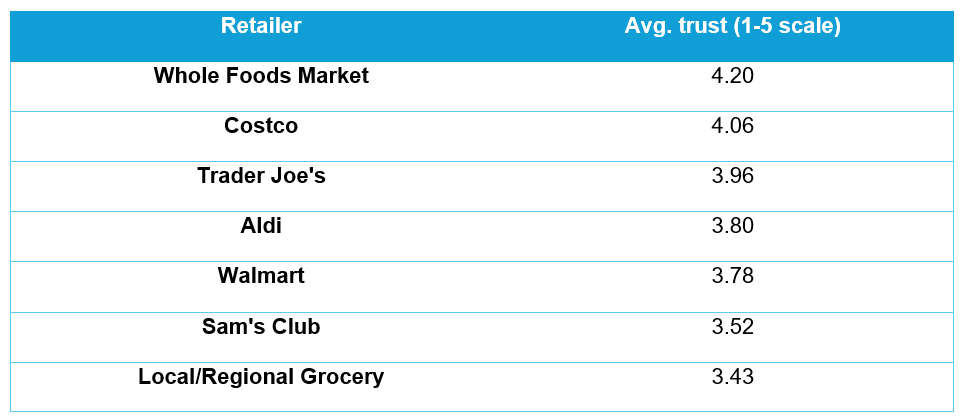
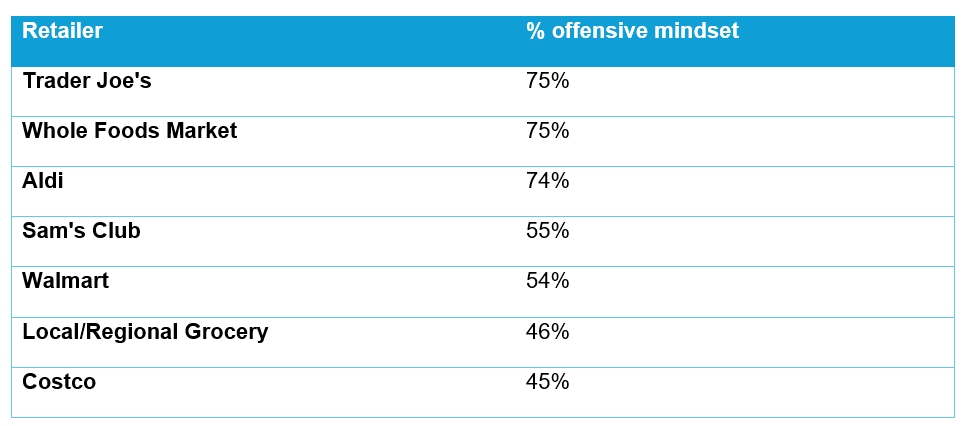
By almost any measure, that's about as trusted as a retail brand gets. So it's striking to see where Costco lands on mindset: We're seeing offensive mindset run as high as 75% elsewhere in this category, and Costco, the second-most trusted retailer we tested, sits at the bottom of the entire list. Not just behind other wholesale clubs. Behind everyone. Even among Costco's most trusting shoppers, the ones who say they trust the brand completely, mindset only climbs to around 54%, still short of where Trader Joe's or Whole Foods sit overall. High trust clearly isn't enough on its own to produce an offensive mindset here, and the gap between Costco's ceiling and the category's ceiling is wide enough to ask whether there's real room to move.
Not Just a Wholesale Thing
Some of that gap is probably the format. Costco is a wholesale club. Shoppers walk in with a list, a membership fee to justify, and a bulk-buying mindset rather than a browsing one, and that setting would naturally produce a more defensive posture regardless of trust. But format alone doesn't fully explain it, because the other major wholesale club in our study, Sam's Club, isn't nearly as far behind the pack:
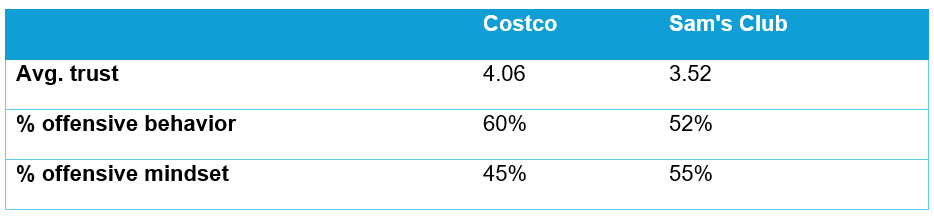
Same bulk-buying mental model, but the less-trusted retailer shows a meaningfully more offensive mindset, closer to the middle of the pack than to the bottom. That rules out "it's just a wholesale club thing" as the full explanation. Something specific to Costco, not the format generally, seems to be holding mindset down.
That's not to say trust buys Costco nothing. Its shoppers already lead Sam's Club on behavior, 60% buy unplanned items often versus 52%. What trust doesn't appear to be buying is a more offensive mindset, and given how far Costco sits from the rest of the category, that gap looks like real, unclaimed upside rather than a hard ceiling.
If Not Trust, Then What?
Trust and good customer service appear to earn a retailer a stable, returning customer base, consistent with what we see in Costco leading on behavior. But trust alone has a ceiling. Costco is about as trusted as a retailer gets, and it's still at the bottom of the mindset list. If more trust were the answer, Costco would already have it. The real question then isn't whether Costco needs more trust. It's what else might move a shopper from hunting for reasons to pass to hunting for reasons to say yes, something trust and loyalty programs alone don't seem built to do.
So what might that something else be? Trust and loyalty tend to build slowly, over years of reliable pricing and service. Mindset looks like it could be running on a different track entirely, something closer to how a store makes a shopper feel while they're standing in it. That's where we're headed next: a look at which emotions actually track with an offensive mindset, and what that might mean for retailers, and brands well outside retail, who want their customers to stop looking for reasons to pass.