

The AI Productivity J-Curve: Why Implementation Matters More Than Ever
August 12, 2026The AI Productivity J-Curve: Why Implementation Matters More Than Ever
August 12, 2026Insights
Offense vs. Defense: A New Way to Think About the Shopping Mindset

Ask any retailer whether they want customers to buy more, and the answer is obvious. But ask a more interesting question - do customers let themselves want more?
Some stores may encourage shoppers to go on offense: leaning in, building a case for the things around them. Others may encourage a more defensive posture: leaning back, scanning for a reason to say no. We conducted a pulse-check study of ~230 grocery shoppers to explore it.
Note: given the sample size, findings should be read as directional rather than conclusive.
Two Dimensions for Measuring
We define offensive vs defensive shopping with two dimensions:
- Behavior: how often someone makes an unplanned purchase
- Mindset: how they process something unplanned once it catches their eye. We define an offensive mindset as answering, "I tend to imagine how I could enjoy or use it," and a defensive mindset as "I tend to consider whether there are reasons to pass on it."
Someone can score high on behavior and low on mindset, or the reverse. A shopper might buy unplanned items constantly while still mentally filtering each one for reasons to skip it. Another might rarely buy unplanned ones but say an enthusiastic yes on the few occasions something grabs them.
Before going further, it's worth explaining why we're treating these as two separate dimensions instead of one:
- On stat level, shoppers with an offensive mindset are somewhat more likely to also show offensive behavior, but the two don't move together nearly as tightly as you'd expect if they were really the same thing.
- On the strategic level, aside from the obvious goal – having shoppers buy more (behavior) – retailers should also make every sell an easier one. The mindset we are measuring offers a useful proxy for that “easy sell” goal.
The Behavior Dimension: Who's Buying Unplanned, and Where?
Overall, 63% of shoppers say they make unplanned purchases almost every time or often. That rate shifts quite a bit by retailer.
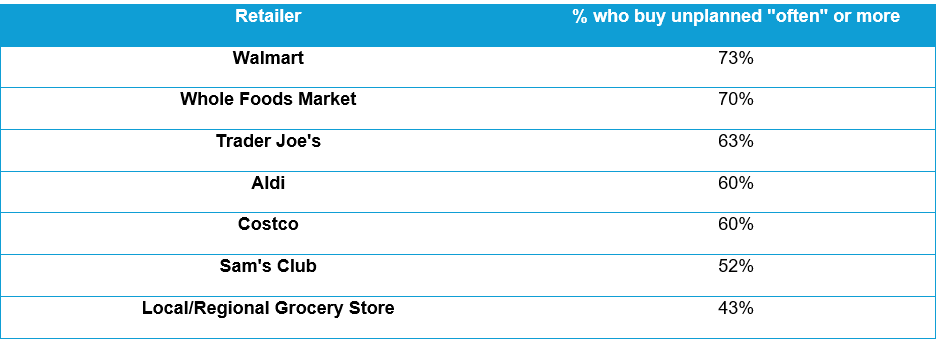
Walmart has the highest reported rate, 73% against a 63% average. Some of that may reflect sheer SKU count; some may reflect how open shoppers feel while walking around the store. Local and regional grocery stores have the lowest reported rate, at 43%. Shoppers there appear more likely to stay focused and stick to their list.
The Mindset Dimension: Who's Leaning In, and Where?
Mindset tells a different story. Overall, shoppers split 56% offensive to 44% defensive, a near-even mix that leans slightly toward leaning in.
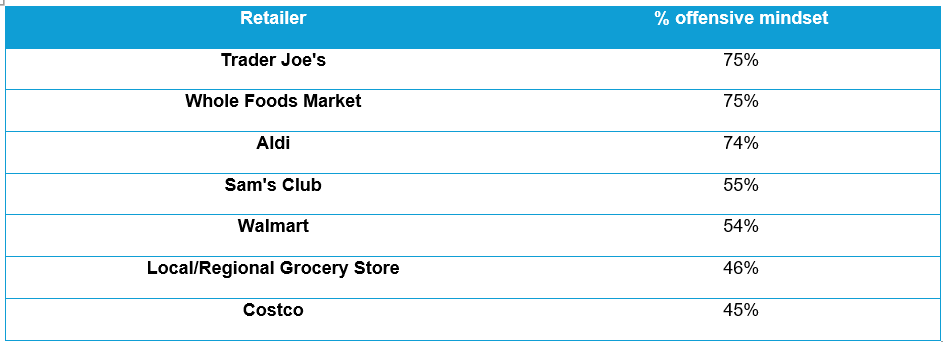
Trader Joe's, Whole Foods, and Aldi have the highest shares of offensive-mindset responses. Shoppers at these three appear most ready to say yes. Walmart, the leader on reported behavior, sits at 54% on mindset, near the middle of the group. Costco has the lowest reported mindset score despite being a widely trusted, well-liked brand (we will discuss this more in the next article).
Is This About the Person, or the Store?
Behavior and mindset appear to be two separate axes, and retailers do not rank the same way on both. Walmart has the highest reported rate of unplanned purchasing but sits near the middle on mindset. Trader Joe's, Whole Foods, and Aldi have the highest offensive-mindset shares. Costco has the lowest mindset score despite strong brand trust. Personality may shape the baseline, while differences across stores suggest that context may also influence how a shopper shows up.
That last point sets up the next question. If store context helps shape mindset, what might explain the differences? Trust? Customer service? Something else? That's where we're headed next, starting with a closer look at Costco: how might a wholesale retailer encourage more shoppers to lean toward the offensive side?
Where This Leaves Us
A natural question here: is offensive or defensive mindset a personality trait people carry with them, or might the store context help shape it?
Our survey responses suggest an association with personality: shoppers who describe themselves as more open-minded also tend to report more offensive mindsets and behavior.
The store context may matter too. We looked at shoppers who answered for two different retailers in our study and compared how many reported the same mindset in both stores with how many switched. About half reported different mindsets across the two stores.
Taken together, these findings suggest that personality may set a baseline while the store context may also influence whether shoppers lean toward or away from an offensive mindset.