

Trust vs. Mindset: What Costco Shoppers Tell Us
October 7, 2026Trust vs. Mindset: What Costco Shoppers Tell Us
October 7, 2026Insights
What Gets Shoppers to Say Yes?

In the first article, we split offensive shopping into two things: behavior, whether a shopper buys the unplanned item, and mindset, whether they go looking for a reason to say yes or a reason to pass. In the second, we tested the most obvious explanation, trust. Costco, one of the most trusted retailers in our study, had the lowest share of offensive-minded shoppers of any chain we measured. Trust tracked closely with behavior. It barely moved mindset.
So what does? One place to look is how shoppers feel in the moment, and that’s what this last article explores. Because the study covers 226 shoppers, the findings below are directional rather than conclusive.

Not All the Positive Feelings Do The Same Job
Each shopper told us which of 16 feelings they experienced while shopping at a given store. We compared the share with an offensive mindset, and with offensive behavior, among shoppers who felt each one and those who didn’t.
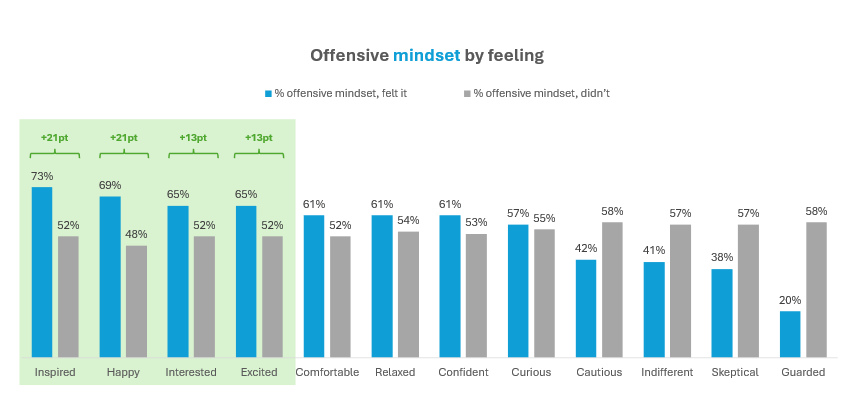
Four feelings stand out: Inspired, Happy, Interested and Excited. Each goes with a 13 to 21 point lift in offensive mindset (and a similar 14 to 16 point lift in offensive behavior). The comfort feelings show smaller gaps that could easily be noise. Feeling at ease doesn’t appear to be what gets someone to say yes. Feeling pulled in does.
The Feelings Add Up
The effect looks cumulative. Among shoppers who reported none of the four energized feelings (Happy, Inspired, Interested, Excited), 43% had an offensive mindset. With one, it was 55%. With two, 63%. With three or more, 73%.
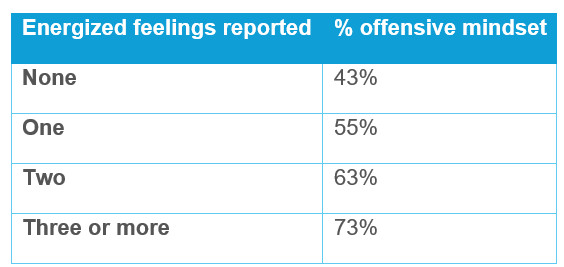
Behavior moves in the same direction, though less evenly. The pattern holds when we account for which store the shopper was in, and when we account for how often they buy unplanned items. In other words, it isn’t just a retailer effect, and it isn’t just frequent buyers feeling good about buying.
A note of caution. This is correlation. A shopper who feels inspired may be more open to saying yes, or a shopper who is already leaning toward yes may feel inspired. We can’t tell which comes first. Either way, the two go together.
What This Could Mean for Brands
The rest of this section is our interpretation, not something the data tests directly.
Aim for lift, not just ease. A lot of retail and brand effort goes into making experiences comfortable and frictionless. That matters for trust and repeat behavior, as we saw with Costco. But the feelings most closely tied to an offensive mindset are the energized ones. A smooth experience may keep shoppers loyal without getting them to lean in.
Give people something to imagine. Our definition of an offensive mindset is imagining how you could enjoy or use something. Moments that invite that, like a new flavor to try, a use case you hadn’t considered, or a display that shows a product in action, may do more than another reassurance about quality or price.
This applies beyond the store. The same logic could hold wherever someone decides whether to try something new: a product launch, an upgrade offer, a new feature in an app. If the moment feels inspiring or interesting, people may be more likely to ask how they’d use it. If it feels like a pitch, they may start looking for the catch. These are hypotheses worth testing, not findings from this study.
Where This Leaves Us
Across three articles, the picture is consistent. Shoppers differ in how often they buy unplanned items, and in how they shop when something catches their eye.
When we shop offensively, we're actively looking for a reason to buy. Give us just one, whether it's a discount, a use case, or something else, and we'll take it. When we shop defensively, we're scrutinizing everything, and one unchecked box is enough to pass.
Trust helps explain how often shoppers buy and does little to explain which side of the ball they're on. Feelings in the moment, especially inspired, happy, interested and excited, go with the offensive mindset. A loyal shopper can still play defense, as Costco's numbers show.
So for any brand that wants customers to shop offensively, the question may be less "how much do they trust us?" and more "what are we giving them to get excited about?" If we want shoppers to let themselves want more, we have to give them something worth wanting.