

Offense vs. Defense: A New Way to Think About How People Shop
September 17, 2026
Why Growth-Stage B2B Technology Companies Need Market Research
March 6, 2026Offense vs. Defense: A New Way to Think About How People Shop
September 17, 2026Why Growth-Stage B2B Technology Companies Need Market Research
March 6, 2026Insights
The AI Productivity J-Curve: Why Implementation Matters More Than Ever
What Anthropic's $150M Initiative Says About AI Implementation

Last month, Anthropic announced Claude Corps, a $150 million initiative to place AI fellows inside nonprofits. While many viewed it as another workforce development program, we believe it revealed something more important: the biggest challenge in AI is no longer building better models. It's helping organizations use the models they already have.
This challenge isn't new. Economists Erik Brynjolfsson, Daniel Rock, and Chad Syverson described it years ago as the productivity J-curve. When organizations adopt a transformative technology, productivity rarely improves overnight. Instead, performance often declines as teams experiment, processes evolve, and organizations learn how to integrate the technology into everyday work. Only after these organizational changes take hold do meaningful productivity gains emerge.
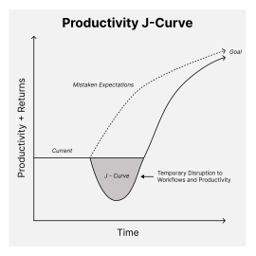
This framework explains much of what we're seeing with AI today.
Most organizations already have access to remarkably capable AI models. Yet many continue to struggle to generate measurable business value. The bottleneck is no longer the technology itself, it's the organization's ability to implement it effectively on a human-level.
Successful AI adoption isn't about choosing between Claude, ChatGPT, or Gemini. It's about understanding where work slows down, how decisions are made, where knowledge breaks down, and what customers and employees actually need. These are fundamentally human challenges.
That's what makes Anthropic's announcement so significant. Rather than investing another $150 million in model development, Anthropic invested in people whose role is to help organizations redesign workflows, train employees, and embed AI into daily operations. It's a recognition that implementation, not intelligence, has become the limiting factor.
The question isn't whether organizations will experience the bottom of the J-curve. Most will. The question is how quickly they can move through it.
Our own research earlier this year points in the same direction (Check out full report here).
In this study focusing on building AI proficiency in the workplace, we found that technical capability was only one part of the equation. Organizations make faster progress when they remove barriers to adoption, build skills through real work, create a culture of experimentation, provide role-specific training, measure what people can actually do, and embed responsible AI practices into everyday workflows.
None of these recommendations focus on the model itself. They focus on people. The companies that realize the greatest return from AI won't necessarily have access to the smartest models. They'll be the ones that understand their organizations well enough to redesign them.
We'd love to hear where your organization is getting stuck. Is it adoption? Skills? Governance? Workflows? Or something else entirely? Reply to this newsletter or reach out to continue the conversation. We're always interested in learning how organizations are navigating AI implementation.
References
Anthropic. Introducing Claude Corps: Building AI Implementation Capacity for Nonprofits. June 2026.
https://www.anthropic.com/news/claude-corps
Brynjolfsson, E., Rock, D., & Syverson, C. The Productivity J-Curve: How Intangibles Complement General Purpose Technologies. National Bureau of Economic Research (NBER Working Paper No. 25148).
https://www.nber.org/papers/w25148
Burnham, K. The "Productivity Paradox" of AI Adoption in Manufacturing Firms. MIT Sloan School of Management, July 9, 2025.
https://mitsloan.mit.edu/ideas-made-to-matter/productivity-paradox-ai-adoption-manufacturing-firms