

Next Gen Tech
August 23, 2025
How Nuanced Is Too Nuanced?
September 10, 2025Next Gen Tech
August 23, 2025How Nuanced Is Too Nuanced?
September 10, 2025Insights
How Secure is Your Customer Base in 2025?
Loyal customers are the backbone of any business—but how do you know which ones are truly secure? In our latest article, we explore a 2025-ready approach to loyalty measurement using the Secure Customer Index (SCI®)—a framework that blends satisfaction, repeat purchase, and recommendation into a powerful loyalty metric.
In 2025, 55% of revenue growth in B2B firms came from existing accounts. In today’s dynamic and highly competitive environment, one constant remains: the importance of monitoring, maintaining, and growing your base of loyal customers. But what does loyalty really mean? It’s a concept that marketers and strategists have long tried to define and master. Loyalty is more than just satisfaction; it reflects a deeper, ongoing relationship between customer and brand.

Behavior that Signals Loyalty
Loyal customers demonstrate several key behaviors that make them valuable:
- Advocate: willingly share positive experiences
- Repurchase: continue buying when needs arise
- Commit: express clear preference and satisfaction
Loyalty vs. Satisfaction
While related, satisfaction and loyalty are not the same. Customer satisfaction is a component of loyalty, but not its entirety. A customer may be satisfied with a product or service but choose not to return—perhaps because of changing preferences, a one-time need, or competitive offers.
For instance, a traveler might thoroughly enjoy a resort stay but have no immediate plans to revisit the destination. Similarly, customers may divide their purchases among multiple providers even if they are satisfied with each. And profitability often tells a third, crucial story – more on that below.
The Profitability Paradox
Some loyal customers may consistently purchase from your business but do so in ways that are not cost-effective—such as through high service demands or frequent returns. It is essential to assess customer loyalty alongside profitability. Identifying these segments can help tailor strategies to improve their value or reallocate resources to higher-value customers.
Measuring Loyalty: The Secure Customer Index (SCI®)
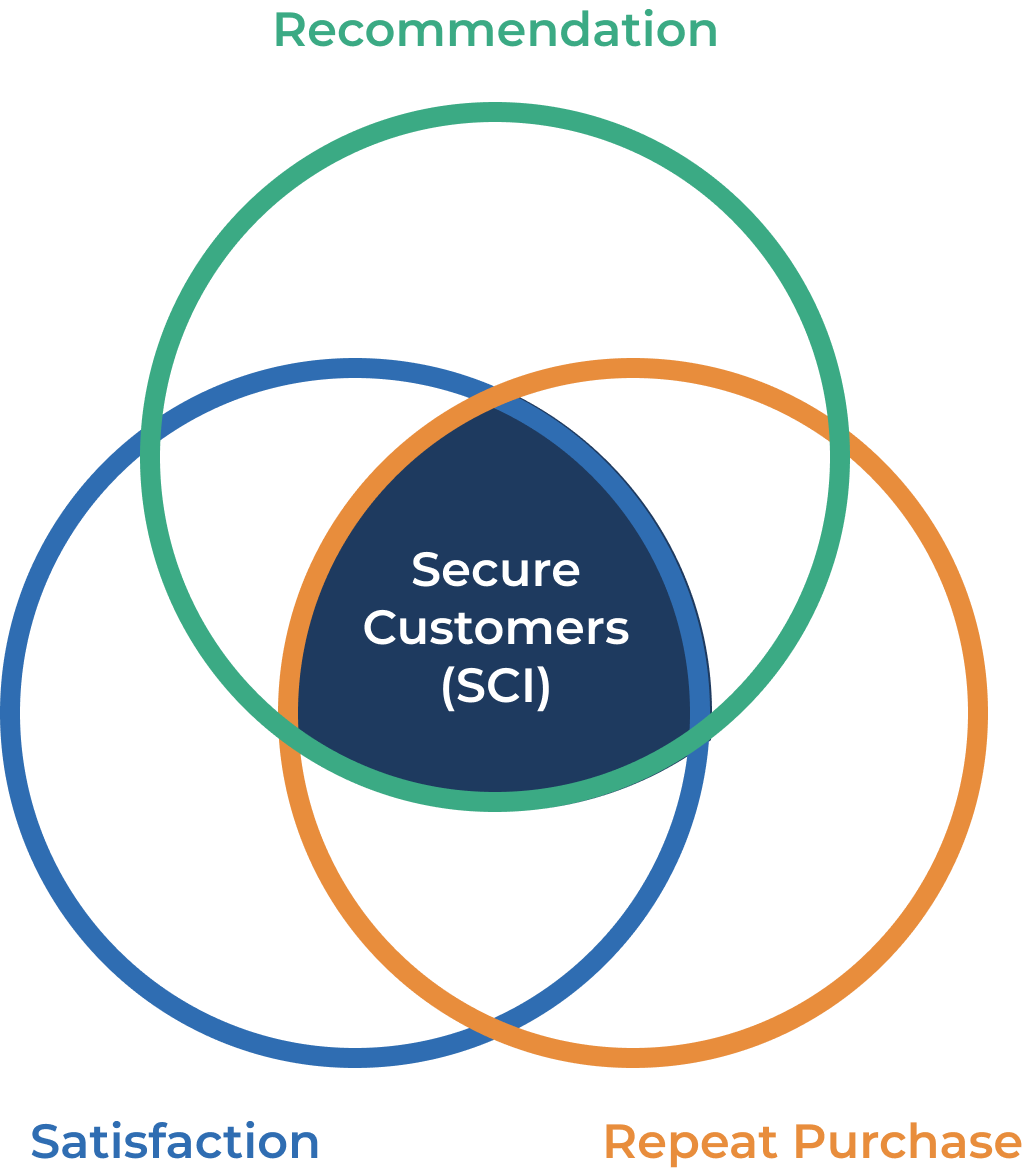
Developed by D. Randall Brandt, PhD at Maritz Research in 1996, the Secure Customer Index® (SCI) is a powerful tool for measuring loyalty in a structured, quantitative way. The SCI can be integrated into customer satisfaction surveys and is based on three indicators:
- Overall satisfaction
- Likelihood of repeat purchase
- Likelihood of recommendation (akin to Net Promoter Score or NPS)
A "secure customer" scores in the top two box (9 or 10) on all three indicators, typically using an 10-point scale (0–10); some firms may use (1-5. These individuals are not only very satisfied but also highly likely to repurchase and recommend your brand—making them strong candidates for retention and growth efforts.
Customers scoring 7 or 8 may be considered “loyal” or “favorable”. They might need targeted interventions to strengthen their commitment. Those scoring lower (5-6 “vulnerable”; ≤4 “at risk”) could churn and should be monitored closely.
What to do Next?
After integrating the SCI items into your next survey, you can instantly segment respondents into Secure, Favorable, Vulnerable, and At-Risk groups and link each segment to profitability or CLV to uncover where revenue is gained or leaking. With that clarity, focus retention perks on Secure customers, conversion nudges on Favorables, and targeted service-recovery fixes on Vulnerable and At-Risk accounts—turning the metric into an actionable roadmap.
Enhancing Measurement with Qualitative Insights
While quantitative data like SCI offers clarity, qualitative feedback adds depth. Open-ended questions can reveal why customers hesitate to recommend, repurchase, or report full satisfaction. These insights can guide targeted improvements in product, service, or communication.
Loyalty in a Digital World
In 2025, customer loyalty is increasingly influenced by digital interactions. Mobile apps, personalized email campaigns, AI-driven customer service, and seamless omnichannel experiences all play a role. Loyalty programs are more data-driven, predictive, and responsive. Businesses that invest in these areas are better positioned to nurture secure customer relationships.
The Data Privacy Imperative
As loyalty measurement becomes more data-intensive, respecting customer privacy is paramount. Compliance with regulations like GDPR and CPRA isn’t just a legal requirement, it’s a trust-building opportunity. For instance, embed a just-in-time notice explaining why you ask for repurchase intent and how that answer will be used. Transparent data practices and clear value exchanges for personal information are critical to maintaining long-term relationships.
The Bottom Line
Start by benchmarking your SCI this quarter and then let the insights steer where you invest in 2026. Understanding and enhancing customer loyalty is vital in both consumer and B2B contexts. Tools like SCI provide measurable insights, but the real power lies in combining metrics with profitability data and qualitative feedback. When done responsibly and strategically, loyalty measurement becomes a roadmap to profitable growth.
Getting to know your loyal customers is more than just good business—it’s a competitive necessity in today’s market.